
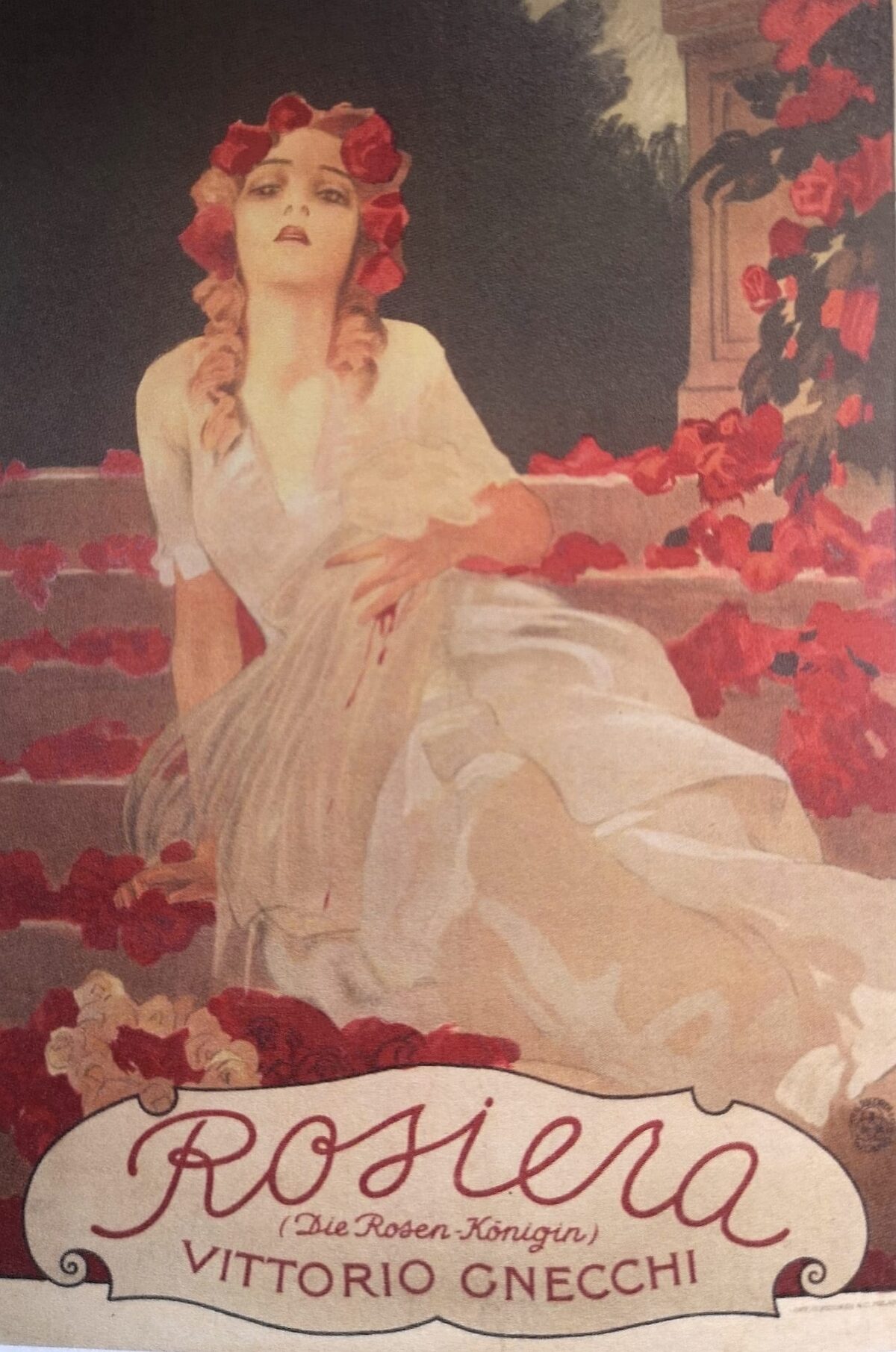
For the 150th Anniversary of the birth of Milanese composer Vittorio Gnecchi Ruscone (1876–1954), soprano Denia Mazzola Gavazzeni and the Ab Harmoniae Onlus Association, in collaboration with Fondazione MIA of Bergamo and Serate Musicali of Milan, presented La Rosiera by Vittorio Gnecchi Ruscone, a three act opera based on a libretto by Carlo Zangarini. The performance of the restored first (1908) version took place on 26 January 2026 at the Giuseppe Verdi Conservatory, Milan.
At just nineteen, Vittiorio Gnecchi composed and staged the “azione pastorale” Virtù d’amore at the theatre of the family villa in Verderio, a work later published by Giulio Ricordi. Passionate about ancient tragedy, he then collaborated with Luigi Illica on the libretto for Cassandra, based on Aeschylus’s Oresteia, which premiered in Bologna in 1904 to great success under the baton of Arturo Toscanini. The triumph of Cassandra was followed by the first drafts of La Rosiera, a tragic idyll to a libretto by Carlo Zangarini, inspired by Alfred de Musset’s novella On ne badine pas avec l’amour.
The compositional style of La Rosiera, while employing post‑Wagnerian chromatic harmonies, remains rooted in classical forms, creating a narrative that rises from elegiac tones to tragic intensity.
The opera is set at the end of the 18th century. “Rosiera” is the nickname of Rosetta, an orphan, and adopted sister of Camilla and niece of the Baron of Salency. The Baron is determined to marry her to his son Perdicano. Rosetta, naive and simple, falls prey to Perdicano’s seduction, though his true love is Camilla, his cousin and childhood companion. Camilla, under the strict control of her governess Pluche, hides her growing feelings for Perdicano by deciding to enter a convent. Jealousy and passion ultimately drive her to betray her friend Rosetta. When passion finally erupts between Camilla and Perdicano, Rosetta, devastated, takes her own life by cutting her wrists with a sickle.
La Rosiera confirms Gnecchi’s sensitivity and profound literary and musical culture. Acclaimed in German‑speaking countries, he was unjustly forgotten in Italy, largely due to accusations of plagiarism involving Richard Strauss. When Strauss’s Elektra premiered in 1909, musicologist Giovanni Tebaldini noted similarities with Gnecchi’s Cassandra. The controversy proved deleterious only for Gnecchi, who was never able to clear his name.
La rosiera was not performed until 1927, some two decades after it was written, in Gera, Germany and is German as Die Rosenkönigin. After performances in Czechoslovakia, Vienna and the Netherlands, it finally received its Italian debut in Trieste in January 1931. There are no records of it having been performed publicly since the early 1930s.
A longtime admirer of Gnecchi’s harmonic and contrapuntal style, soprano Denia Mazzola was the first modern interpreter of Clitemnestra in Cassandra (Festival Radio France et Montpellier, 2000) and performed the Missa Salisburgensis (Lode in Musica per Santa Maria di Caravaggio, 2006). Her work aligns with the mission of the Ab Harmoniae Onlus Association, which she founded to revive unjustly forgotten musicians.
It was Mazzola Gavazzeni who invited composer and musicologist Marco Iannelli to restore and orchestrate the original 1908 version of La Rosiera, long considered lost. Iannelli, author of Il Caso Cassandra (Luigi Illica Prize, 2009), is a leading expert on Gnecchi’s music and serves as Artistic Director of the Vittorio Gnecchi Ruscone Musical Association.