THREE scenes. approximately 90 minutes WITHOUT INTERMISSION.

Programme details
Among the many Chinese who found cultural and intellectual inspiration in Paris between the World Wars were a number of now well-known artists, writers and musicians: Sanyu, Lin Fengmian, Pan Yuliang, Li Jinfa, Xu Xu, Shao Xunmei, Xian Xinghai, Ma Sicong.
This story of impoverished artists, equal parts humour, romance and tragedy, happiness and sadness, tells a completely recognisable and relatable tale of a group of young people in the period of self-discovery between feckless youth and adult responsibility.
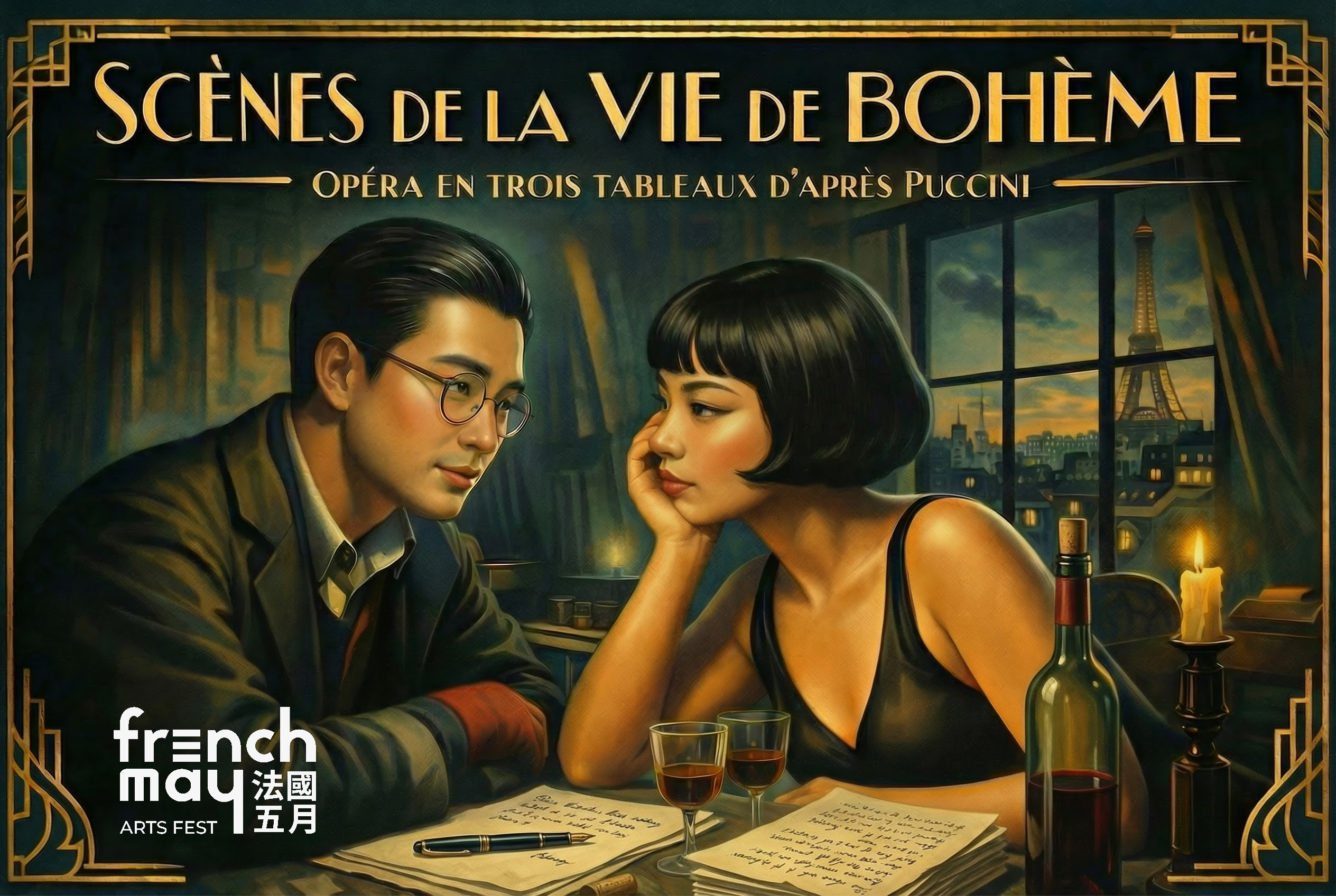
Echoing the classic French novel by Henri Murger, based on the iconic opera by Italian composer Giacomo Puccini and sung in French, Scènes de la vie de Bohème is an intimate dramatic adaptation of Giacomo Puccini’s classic opera. Reduced to the four principal roles, this new version is designed to focus on the emotional ties between the two couples while telling a story of the Chinese cultural diaspora in Paris: a story of love, loss, art, poverty and the richness of life.
- Organised by the Minor in European Studies, Department of English and Communication, and the Culture Promotion Committee of The Hong Kong Polytechnic University, French May Arts Festival, and Opera Hong Kong
- Supported by The French Consulate in Hong Kong and Macau, The Dante Alighieri Institute, and The European Union Office to Hong Kong and Macau
- Music by Giacomo Puccini
- French lyrics by Paul Ferrier after the libretto by Henri Meilhac and Ludovic Halévy
- Narrations from the novel by Henri Murger
- Adapted by Peter Gordon
- Musical adaption by Marco Iannelli
- Directed by Chen Yong
- Featuring
- Etta Fung as Mimi
- Chen Yong as Rodolphe
- Vivian Yau as Musette
- Lam Kwok Ho as Marcel
- Arièle Zanini on piano
- MC: Charlene Juthamat Saengsuk
Thanks to:
- Professor Renia López
- Dr Christelle Davis
- Lam Sze Ngo
- Emmanuel Chan (Christie’s) for assistance with Art History and Artwork selection
- Stage manager: Franco Savadori, with assistance from
- Bright Ogbonna
- Front of house
- He Jingyang
- Huang Shuming
- Li Xinrui
- Mavis Emefa Dunyo
- Tan Kexin
- Tu Dan
Message from the Consulate-General
The Consulate General of France in Hong Kong and the French May 2026 is delighted to support “La Vie Bohème 2026” presented by the Minor in European Studies of the Hong Kong Polytechnic University and Opera Hong Kong.
Henri Murger’s Scènes de la vie de bohème captures a timeless French spirit of artistic passion and creative freedom. We are proud to see this heritage celebrated here in Hong Kong, and we commend PolyU for its ongoing commitment to deepening cultural and academic ties between France and our city.
We wish all the artists and audience members a truly inspiring journey into the heart of the bohemian soul.
Johanna Bouyé, Consul for Education, Science and Culture
Henri Murger & “La vie bohème 2026”
Henri Murger’s novel “Scènes de la vie de bohème” is a vivid portrait of young artists and intellectuals scraping by in the Latin Quarter of 1840s Paris. In the 175 years since the novel was first published, it became the template for generations of “starving artist” narratives and inspired a lineage of adaptations from Puccini to Broadway. His vision crystallized a cultural archetype—one that continues to define how we imagine the creative life. Throughout 2026 we will paying homage to “La vie bohème” in art, music and film.
Synopsis
Prologue: A writer’s lover dies in the hospital. He turns to write…
Scene 1: A garret in Paris between the Wars ~ Rodolphe and Marcel, impoverished Chinese poet and painter respectively, share a small flat and are constantly hungry. Marcelo’s on-again, off-again flame, the singer Musette, arrives with food and drink earned by entertaining an elderly expat. Marcel is furious but can’t resist her. They agree to all go to Wan Chai to spend her earnings. Rodolphe stays behind to finish an article and there’s a knock at the door: it’s Mimi, a (beautiful) neighbour. Her light has gone out and in the darkness, she drops her key. They look together; Rodolphe finds it and pockets it — and finds her hand instead. They introduce themselves to each other and fall in love; the scene ends as they go off to join Marcel and Musette, arm-in-arm, proclaiming their love for each other.
Entr’acte: Paris audiences hear some of thee first performance of Chinese songs, courtesy of Musette.
Scene 2: some time later ~ The poor living conditions have taken a toll on the relationship. Mimi tells Marcel that Rodolphe is jealous and wants to break it off, but they don’t know what to say to each other. Rodolphe comes to speak to Marcel, while Mimi hides. Rodolphe tells Marcel that he wants to leave Mimi because she’s a flirt, but then admits that Mimi is in fact so ill that she is dying. He can’t care for her in his squalid flat. Mimi hears and comes out. She says she’ll leave but the two lovers convince themselves to stay together until the Spring when the flowers are in bloom.
Scene 3: a few months later ~ Marcel (who has had a fight with Musette) and Rodolph are mourning their lost loves when Musette bursts in, saying that Mimi is with her and is very, very ill and wants to be with Rodolfo whom she hopes has been waiting for her. Mimi comes up; Marcel and Musette leave to fetch a doctor and buy medicine. Rodolphe and Mimi recall their meeting, their happy days and renew their love, but it’s too late. Once Marcel and Musette return, she quietly expires in the arms of her friends.
Cast and creative

Etta Fung is one of Hong Kong’s leading coloratura sopranos and has sung leading roles with Hong Kong’s major opera companies, as well as overseas, and is the creator of Opera Sull’Aria in which she performs arias in the air combined with aerial silks.

One of Hong Kong’s most accomplished tenors, Chen Yong has sung leading roles with opera companies and orchestras in Hong Kong, China and Europe.

Hong Kong soprano Vivian Yau has appeared on the world’s major stages, from New York’s Carnegie Hall to the Cultural Centre in her native Hong Kong.

Lam Kwok Ho is one of Hong Kong’s most recognizable baritones, regularly appearing with such companies as Opera Hong.
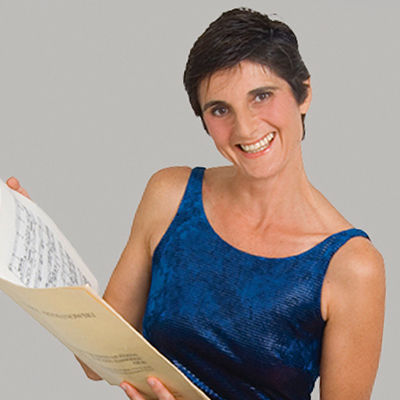
Arièle Zanini is the Principal Piano for the Hong Kong City Chamber Orchestra.